
Why Some People Are Better At AI

Some people pick up AI tools and immediately get results. Others use the same tools and get garbage. The gap isn't intelligence. It's not technical background. It's not even experience.
It's how they communicate.
It's just language
Large language models are, at their core, a way to compress and replicate human communication. They've processed an enormous volume of written language and learned to reproduce patterns from it. That's the whole mechanism.
So the best users of AI are people who are already good at communicating clearly — specifically in writing. Not creatively. Not eloquently. Speaking to be understood.
Albert Einstein once said, "If you can't explain it to a six year old, you don't understand it yourself."
If you can say what you mean in a way that leaves little room for interpretation, you get back what you asked for. If you can take a complex process and break it down into simple steps, you can show a machine how to help. If you can't do either of these, the model fills in the gaps with its best guesses - and the distance between intention and execution gets very big very quickly.
The linguistic edge
People who've learned a second or third language have an advantage here that's hard to articulate but easy to observe. Learning another language forces you to strip meaning down to what's essential. You stop relying on tone and implication and cultural shorthand. You learn to focus on effectively conveying your message, not on picking the best possible words.
That's exactly the discipline that makes a good AI user. You're not writing for a person who can read between the lines. You're writing for a system that needs you to speak frankly and takes you at your word.
The same linguistic advantage shows up in people who write a lot professionally, people who've worked in legal or technical fields, teachers and trainers, and anyone who's spent time having to explain complex things simply.
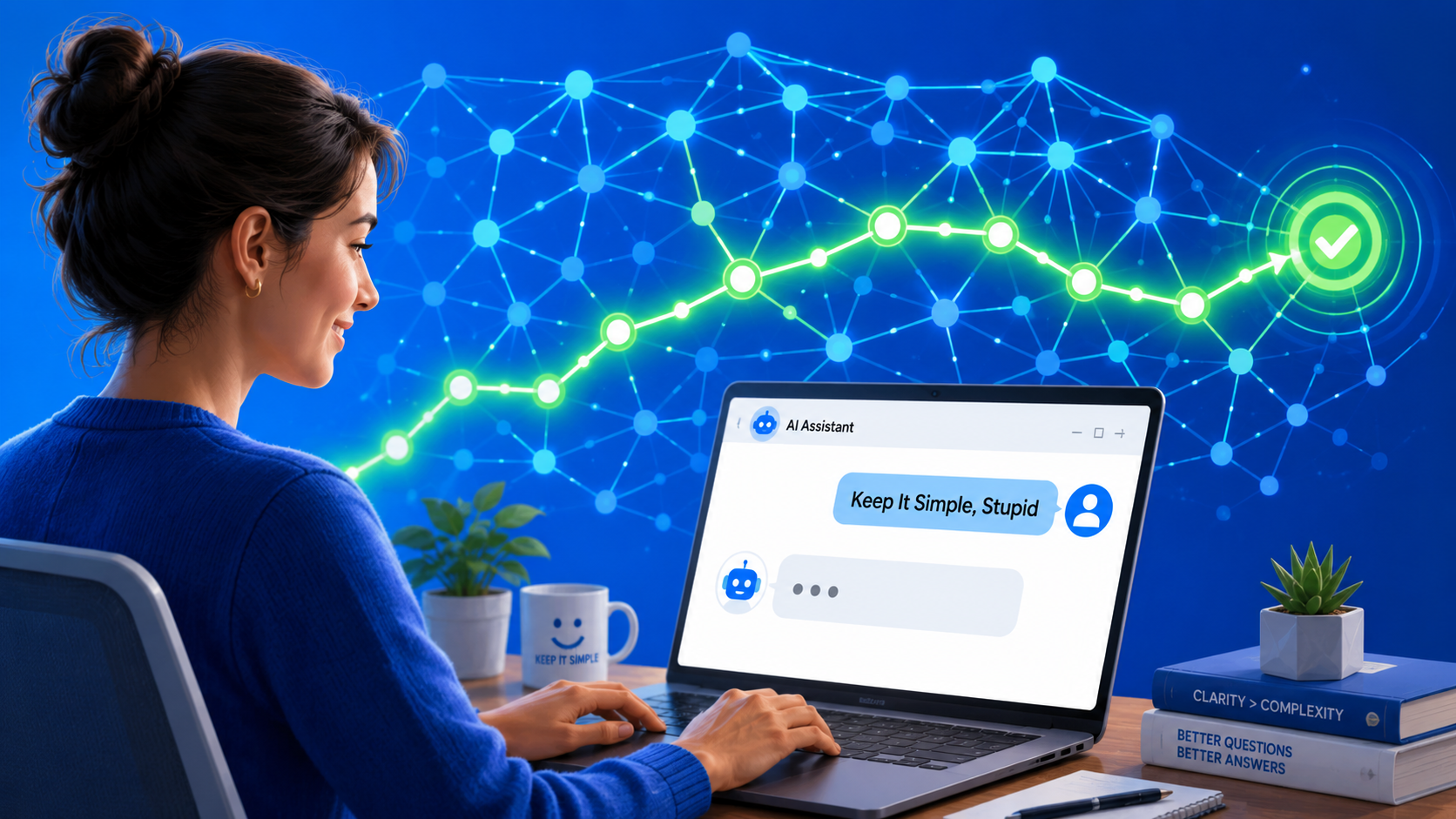
Let's practice: Get to the point, and keep it simple, stupid.
Humility accelerates your learning
The other trait that separates effective AI users from ineffective ones is harder to teach: you have to admit what you don't know.
AI's greatest power is in helping you learn. That compression of language we talked about - it actually pulled in most of the internet's knowledge, too. When you come in with an open question - genuinely curious about how something works, what you're missing, what you don't know to ask - the model's knowledge can help you find a starting point. You leave these brainstorming conversations with vocabulary, frameworks, and context you didn't have going in. That makes your next task better. And when you need to learn the next new thing, you get there quicker.
People who come in assuming they know best tend to use AI as a tool for producing output and not much else. That's useful. It's also just a fraction of what's possible.
What this means for you
Most organizations and businesses aren't getting poor results from AI because they chose the wrong tool. They're getting poor results because the people using the tools haven't developed the skills and habits that make those tools effective — and nobody's told them that's the problem.
That's a training gap, not a technology gap. And it's fixable.
Part of what we do at Mosaic is help organizations understand where those gaps are and how to close them — whether that's through better prompting practice, clearer process documentation, or building systems that make the right behavior the default.
AI doesn't have to be a specialist skill. But it does require getting back to basics, which is a skill many professionals haven't developed.
Mosaic Solutions is an AI strategy and automation consultancy based in the Cedar Rapids/Iowa City Corridor. Get in touch.