
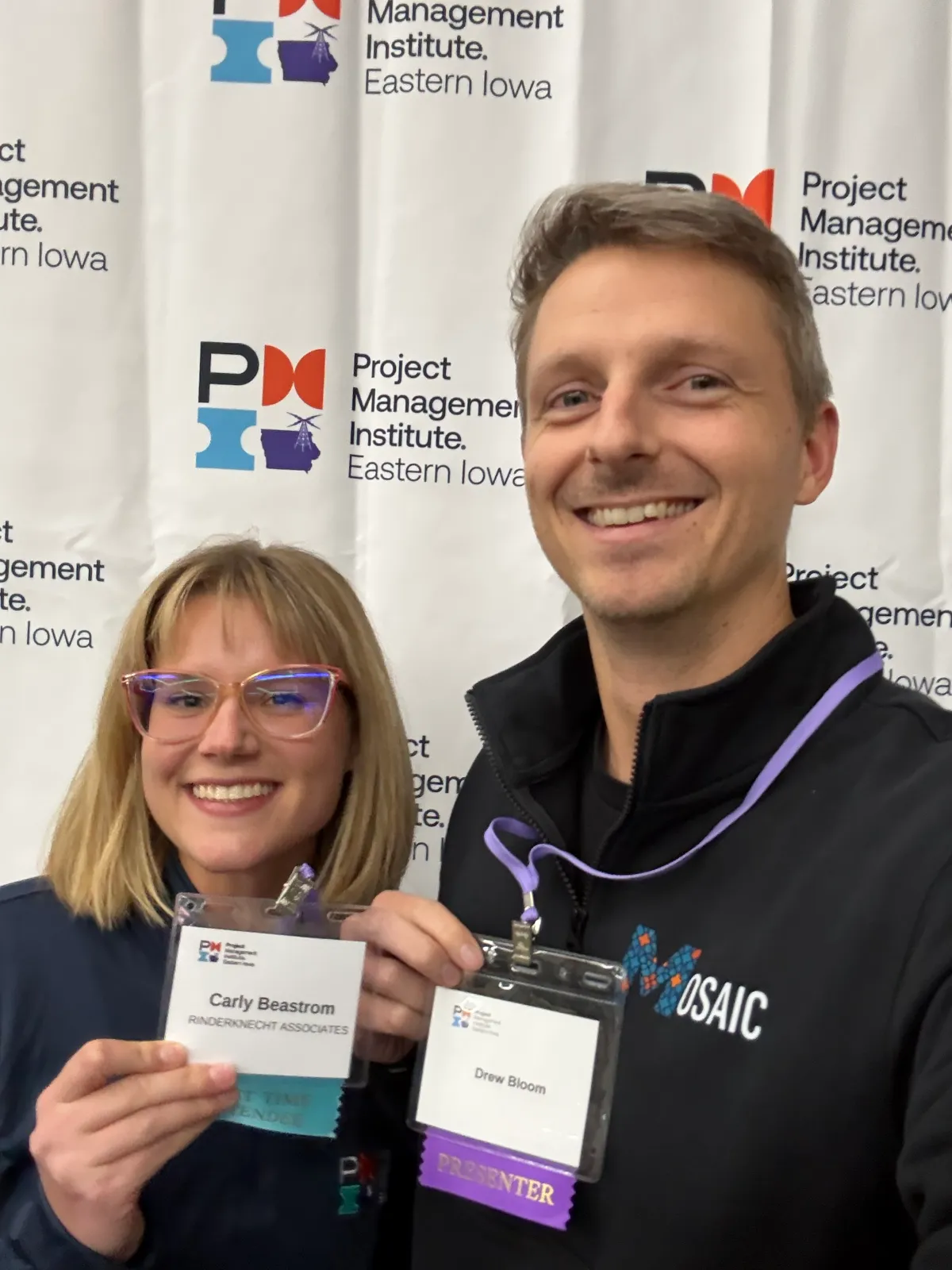
On Friday, October 16, 2026, I gave AI for Project Management: Conversations for Skeptics, Beginners, & AI Champions at PMI Eastern Iowa's Professional Development Day, at The Hotel at Kirkwood in Cedar Rapids. The short version: the most valuable thing AI can do for a project manager is teach you, and fifteen minutes a day of learning with it adds up to more than any single training.
PMI's calendar listed the session as AI for Meetings and Systems in Project Management. The day's theme was the evolution of project management, as the chapter marked its 45th anniversary, which made it a good room to ask what changes next. This is a recap in broad strokes. The session itself goes further, and if you'd like it for your own team or event, the speaking page is the place to start.
Who was in the room?
The title named three kinds of people on purpose: skeptics, beginners and AI champions. A room of project managers holds all three, and a session that only speaks to one of them loses the other two in the first ten minutes.
So we started with a check-in. Everyone placed themselves on the AI Proficiency Scale, the three levels Mosaic uses to decide where training should start:
| Level | What it looks like | The next question to ask |
|---|---|---|
| Beginner | Uses AI rarely, or with uneven results | What could help me today? |
| AI Champion | Gets repeatable results that others use | What repeats, and who else could use it? |
| Systems Builder | Redesigns the work itself, and knows when not to use AI | What system should exist? |
The point of the check-in isn't to rank anyone. A level is where you start, not a grade, and you can be a Systems Builder in one part of your job and a Beginner in another. Skeptics answered too: if you did start, where would it be?
Then the harder question: where is most of your team? That answer decides what their training should look like, one level at a time. In the session, we go further into how to read where a team really is, and why the guess is usually wrong.
Why "AI as your teacher"?
Early on, I showed AI doing the part of project management that's already solved: a few seconds of instruction on my phone, and the notes, contact, time entry and follow-up tasks from a recorded meeting landed in a CRM without anyone typing them. Many people in the room already work this way. For the ones who don't, it's an easy fix.
But that isn't where the lasting value is. Paperwork is the servant's job. The bigger opportunity is understanding your own work well enough to hand more of it off, and that takes learning.
The most valuable thing AI can do for you is teach you. Not your servant. Not your magician. Your teacher.
A servant does what you say, and you learn nothing. A magician fascinates you, and you never understand how the trick works. A teacher leaves you able to do it yourself. Terry Doyle put the principle simply: whoever does the work does the learning. When AI does all the work, AI does all the learning.
In the session, I walk through a simple way to use AI as a teacher, and why it works for skeptics as well as champions.
What does fifteen minutes a day add up to?
The ask for the room was small on purpose: every workday, spend fifteen minutes learning one new thing for your work, figuring it out yourself with AI's help.
Here's the math. Fifteen minutes a day, five workdays a week, fifty-two weeks:
- 75 minutes a week
- About 65 hours a year
- 260 questions you can answer that you couldn't before
To make it concrete, I showed my own last month: real questions from one of my AI accounts. How do roles and permissions work in HubSpot? How should we handle phishing reports? How does gross revenue retention work? None of them is a course. Each one is a question that came up at work, answered well enough to act on.
Then I showed what that habit has added up to for me over a few years: from prompting AI to help me teach, to writing automations, to leading AI transformation, to managing software projects and IT.
The short answer, for project managers
The best way for a project manager to get value from AI is to use it as a teacher before using it as an assistant. Pick one question from your real work each day, such as a term from a vendor meeting, a metric on a status report, or a tool setting you've never understood, and spend fifteen minutes having AI teach it to you rather than hand you an answer, until you could explain it to a colleague. The habit costs about 75 minutes a week. Over a year it's roughly 65 hours of focused learning and 260 questions you can now answer yourself, in the language of the project you're running. That understanding is what lets you decide later which parts of the work are safe to hand off, and which ones still need a person who knows why each step exists.
The session goes deeper on the habit itself: how to keep it going past the first week, and how to turn one person's learning into something the team shares.
What should organizations do?
If self-directed learning is the key for professionals, the obvious next question is what organizations should do about it. This was where the room got most interested.
The short version is ownership, and ownership has two parts:
- Incentives: a stake in what the change saves or earns. Time back, recognition, a bigger role, pay.
- Agency: the freedom and the time to change your own work.
People rarely resist AI because they can't learn it. They hold back because nothing in it is for them. If the only reward for working smarter is more work, nobody changes. Leaders can't order that kind of change into being. They can make it worth someone's while.
I closed this part with one idea that worked when I led innovation at Affinity: an internal Shark Tank, where staff pitch ideas for making their work better. We'll write about that one on its own soon. In the session, I tell the story of what it did there, and why it's harder to run well than it looks.
What did attendees take home?
Everyone left with a guide to the session: the proficiency levels, the learning habit, and the questions for organizations, in one place. It also includes a takeaway for your AI, something you can give your own assistant so it can keep coaching you after the room has cleared out.
That takeaway matters more than any slide. A session lasts an hour. A habit, and a tool that supports it, keep working long after.
Thank you, PMI Eastern Iowa
Thank you to PMI Eastern Iowa's board and volunteers for the invitation, and to everyone who spent part of their Professional Development Day with us. A 45th anniversary is a good moment to ask how the profession changes next, and we're grateful to everyone who stayed to ask questions.
Can we bring this session to our team?
Yes. This session works for PMI chapters, associations and conference audiences, and it adapts well to a single team. For a company, it can run as a hands-on workshop built around your own tools and projects, or as a shorter leadership session focused on the organizational questions. We deliver it onsite in Cedar Rapids, Iowa City and across Iowa, and virtually anywhere.
If you're planning training for staff rather than an event, our AI training for teams covers the formats. For talks, workshops and conference sessions, see Speaking & Workshops and tell us about your audience.