


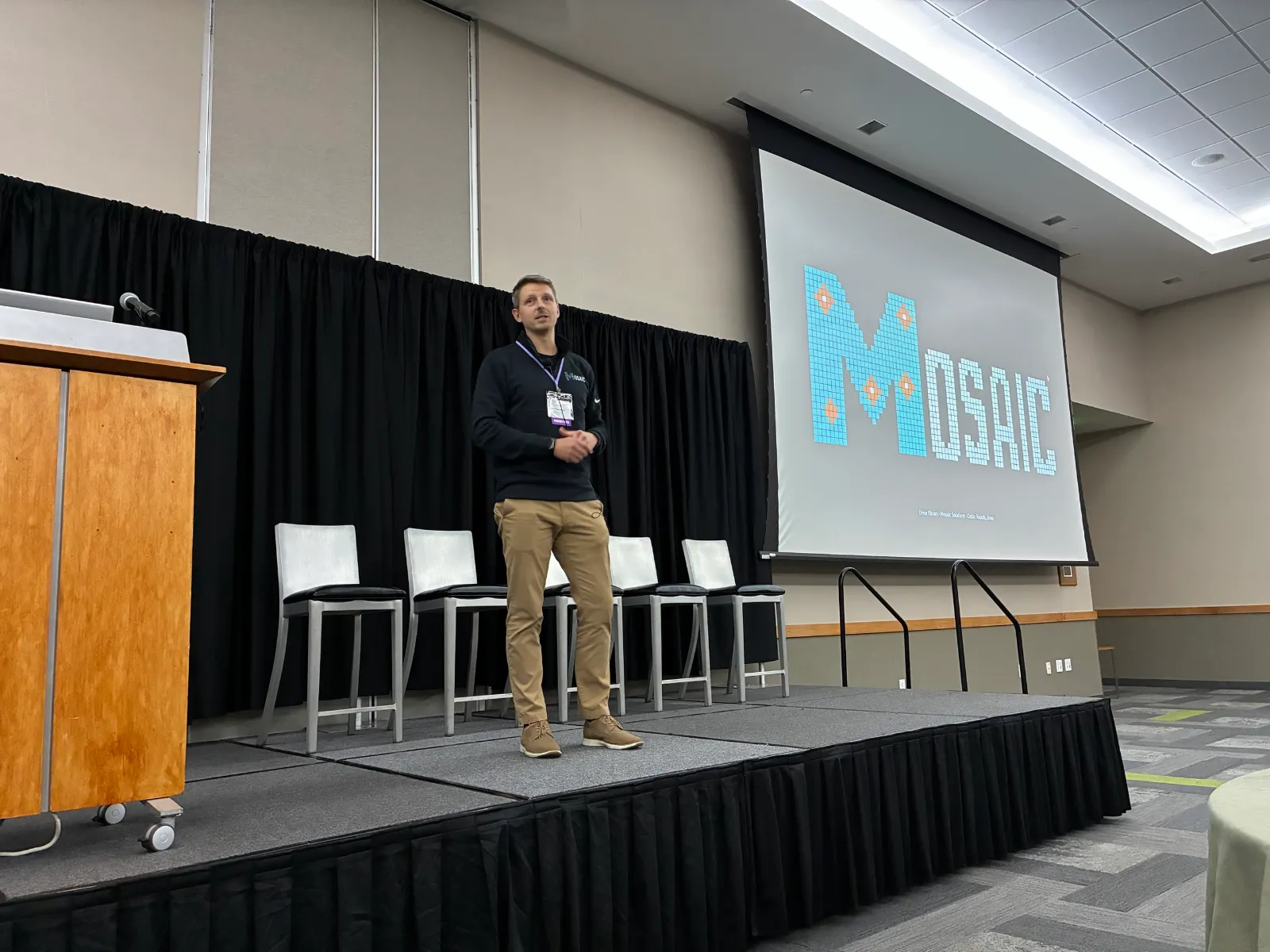
On Friday, October 30, 2026, I gave the closing session at MECA & UMBUG 2026, the joint conference of the Midwest Ellucian Client Association and the Upper Midwest Banner User Group, hosted by Kirkwood Community College in Cedar Rapids. It was a workshop of about 75 minutes on leading organizational change around AI, for a room of higher-ed IT staff, campus leaders and software vendors.
The conference listed the session as The Last Skill Worth Having: An Innovation Mindset for Organizational Transformation. 2026 was the first year the two groups met together, with Banner and Colleague institutions from across the Midwest in one building for two days of sessions on enrollment, financial aid, reporting, data governance and campus technology. This is a recap in broad strokes. If you'd like a session like it for your own group, see Speaking & Workshops.
What was the session about?
A room like this one knows its systems deeply. Many people there have run Banner or Colleague for years, and the vendors in the room build on top of them. So my job wasn't retrieval-augmented generation or AI agents. My job was leadership and planning: how an institution helps its people take on AI in a way that lasts.
That framing matters in higher ed. Campuses rarely lack ideas or tools. What they lack is a reliable way for an idea from the registrar's office or the financial aid team to reach a decision, get built, and stay working.
Where is the room on AI?
We started the way I like to start any mixed room: a check-in on the AI Proficiency Scale. Three levels:
- Beginner: uses AI rarely, or with uneven results.
- AI Champion: gets repeatable results that others use.
- Systems Builder: redesigns the work itself, and knows when not to use AI.
A level is where you start, not a grade. That's especially true on a campus, where the person who knows exactly where a process hurts is often not the person most comfortable with AI. The best opportunity-spotter may be a Beginner in financial aid who has worked the same verification queue for ten years.
In the session we go further: what each level needs next, and why training the whole campus the same way usually reaches only one band of the room.
Why treat AI as a teacher?
Briefly, because it's the most accessible place for anyone to start. AI can be your servant, doing tasks while you learn nothing. It can be your magician, impressing you while you never understand how. Or it can be your teacher, leaving you able to do the work yourself. The teacher is the one that compounds. Terry Doyle put it simply: the one who does the work does the learning.
We covered this in more depth at our PMI Eastern Iowa session on AI for project management, including what fifteen minutes a day of learning adds up to over a year.
What do leaders often forget about change?
This was the heart of the session for the leaders in the room. Two ideas did most of the work.
Change is individual. A leader can't order a person to change how they work. Directives produce compliance: people log in, the usage dashboard looks fine, and the work itself stays the same. Real change happens one person at a time, when someone decides their own work could be better.
Agency and incentives over directives. People change when they have the say, the time and the tools to try, and a reason to: an assurance that improving won't cost them, and a share of what it saves. If the only reward for working smarter is more work, nobody changes. Permission isn't participation.
The short answer for higher-ed leaders
Higher education leaders get further with AI by building the conditions for change than by mandating it. Start by finding out where your people really are, office by office, rather than assuming. Expect the best ideas to come from the staff closest to the work, such as registrars, financial aid officers and IT analysts who know where a Banner or Colleague process is harder than it should be. Give those people agency: the time and the freedom to try changing their own work, and a clear, quick way to propose something bigger. Give them incentives: recognition, a bigger role, or time back, so improving their work doesn't simply earn them more of it. Keep top-down rules for the things that help everyone but no one in particular, such as security, privacy and compliance. Everywhere else, the leader's job isn't to deliver the transformation. It's to make it possible for people to take part in it.
What happened when staff could pitch their own ideas?
To pull this together, I told one story: the internal Shark Tank I ran when I led innovation at Affinity. In broad strokes, staff pitch ideas for making their own work better, leadership and the technology team hear them, the best get built, and the person who pitched helps own the result.
The impact was what made it worth telling. Staff across the company pitched, including teams that had been reluctant about AI. The number and quality of viable pitches rose from one quarter to the next. Non-technical roles gained real implementation skills, which grew the capacity for internal projects. IT got a visible front door for new technology requests. And people had more of a say in where the company was going. The first round's projects streamlined the marketing team's website work, standardized the sales team's RFP process, and led to a new product offering in the consulting line.
It's more involved to run well than it sounds, and in the session I talk about why.
What did the room practice?
Then the room did the work. The activity was Mini Shark Tank, a cousin of Troika Consulting from Liberating Structures. In groups of three, one person plays the client and the other two play consultants. The client answers one question: at work, what's harder than it should be? The consultants ask questions until the group can put the answer into words all three of them understand.
In a higher-ed room, that question finds things quickly. It's the kind of conversation that surfaces the report one person knows how to run, or the handoff between offices that lives in someone's inbox. Most of all, it's a small version of what an institution needs at scale: people who do the work, saying what should change, and being heard.
| Who's on campus | What a session like this gives them |
|---|---|
| Registrar and records staff | A safe place to start with AI, and a way to name the processes that slow them down |
| Financial aid offices | Practice turning a pain point into a clear, specific proposal |
| IT and ERP teams | A shared vocabulary with functional offices, and a better picture of where requests come from |
| Campus leaders and CIOs | Ways to support change without mandating it, and a model for hearing ideas from staff |
Thank you to the organizers
Thank you to the MECA and UMBUG organizers for the invitation to close the conference, to Kirkwood Community College for hosting, and to everyone who stayed through the last session of a two-day event and still played their part in a group of three.
Can we bring this session to our user group or campus?
We're glad to bring this kind of session to user groups, associations and campuses, in Iowa and beyond. It can run as a closing or general session, a hands-on workshop, or a leadership session for a cabinet or IT leadership team. If you're weighing formats, our guide to choosing between an AI speaker and an AI workshop can help. For training your own staff, see AI training.
To plan a session for your group, start at Speaking & Workshops.